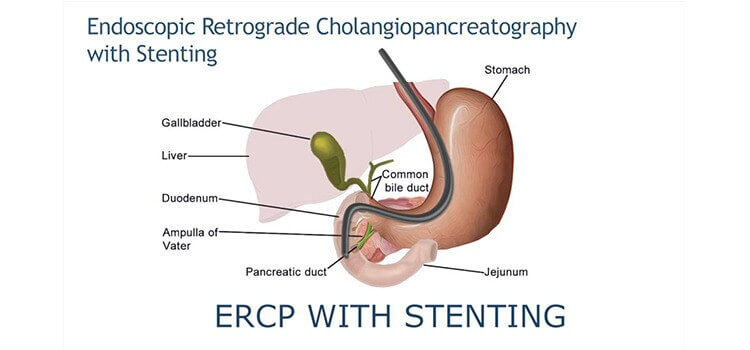
Endoscopic Retrograde Cholangiopancreatography
ERCP is a combination of upper gastrointestinal endoscopy & X rays used to diagnose & treat medical issues related to the gallbladder, Bile ducts, pancreas & liver.
Why is an ERCP required?
ERCP is used in diagnose & treat bile & pancreatic disorders. For diagnosis alone, non invasive techniques like MRI are preferred. ERCP is used when the bile or pancreatic ducts become narrowed as a result of :
- Gallstones
- Infections
- Acute & chronic Pancreatitis
- Bile Duct Cancer
- Pancreatic Cancer
- Pancreatic Pseudocysts
How to prepare for an ERCP?
It is important to discuss all the medications currently being used by the patient including vitamin and mineral supplements, medications for arthritis, diabetes, blood pressure, NSAIDs etc. Your doctor would recommend to temporarily stop medications that affect the sedatives.
The doctor would also give the patient the following instructions to be followed prior to the procedure:
- Do not eat or drink anything 8 hours prior to the procedure
- Do not smoke
- Do not chew gum
How is it performed?
Once the sedative is given , the patient is made to lie on a table & an endoscope is carefully inserted down his or her oesophagus, through the stomach & intro the duodenum. The doctor then finds inserts the catheter where the bile & pancreatic ducts open into the duodenum.. He then injects a contrast medium into the ducts to make them more visible. Fluoroscopy is used to analyse the ducts and identify blockages if any.
Certain tools may be attached to the endoscope to
- Unclog narrowed or blocked ducts
- Remove stones
- Collect tissue sample
- Place stents
Since ERCP is an outpatient procedure, the patient would be allowed to go home once the sedative wears off. Rarely, the patient will be required to stay overnight. The patient may experience bloating or nausea for sometime post ERCP & a sore throat for a day or two.
What are the possible risks of ERCP?
- Pancreatitis
- Infections in Bile or pancreatic Ducts
- Excessive bleeding
- Tissue damage
- Perforation in bile or pancreatic duct
After the Procedure:
Patients may take upto an hour to recover from the sedative. If the colonoscopy was performed to remove a polyp , a special diet may be recommended for a week. The patient may feel bloated or have gas for a few hours post procedure. In some cases, there may be some blood in your first stool after the procedure. This is normal and is not a cause for alarm. However, seek immediate medical help if you continue to pass blood in stools or have persistent fever or pain in the abdomen.
If the result of colonoscopy if negative, it implies that there are no abnormalities in the large intestine. In such cases, the doctor may recommend another colonoscopy in 10 years, if there are no risk factors other than age. The doctor may ask to repeat the procedure in 5 years if the patient has a history of polyps.
If the result is positive, that means an abnormal tissue or polyps was found during the procedure. In such cases, a repeat colonoscopy may be recommended in 5-10 years depending on the other risk factors of the patient
FAQs
ERCP is a specialized endoscopic procedure used to diagnose and treat problems in the bile ducts, pancreas, and gallbladder. It is commonly used to remove stones, relieve blockages, or place stents.
ERCP is recommended when there are signs of bile duct obstruction, jaundice, pancreatitis, or abnormal imaging findings. A specialist in Hyderabad may suggest it for both diagnosis and treatment.
No, ERCP is usually performed under sedation or anesthesia, so patients remain comfortable during the procedure. Most people do not feel pain while it is being done.
Patients are typically asked to fast for several hours before the procedure. Your doctor may also provide instructions regarding medications and necessary precautions.
The procedure usually takes 30–60 minutes depending on complexity. Most patients are observed for a few hours and may go home the same day, based on their condition.
ERCP is generally safe when performed by an experienced gastroenterologist, but it carries some risks such as pancreatitis or infection. Proper evaluation and care help minimize complications.



