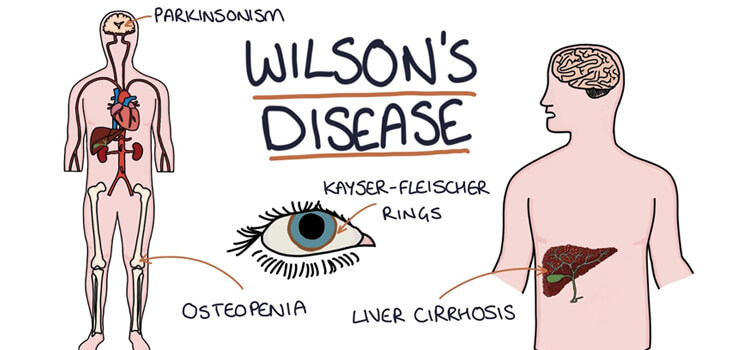
WILSONS DISEASE CAUSES
Wilson’s disease is an inherited medical condition in copper gets accumulated in liver, brain & other organs of the body. This condition is also known as Hepatolenticular Degeneration & Progressive Lenticular Degeneration.
In healthy individuals, the liver flushes out excess amounts of copper & releases it through urination. In individuals with Wilson’s disease, the liver’s inability to remove extra copper leads to build uo of copper in eyes, brain & liver.
Early detection is key to managing this condition. If left untreated, it can lead to liver damage or other serious complications. Consult a gastroenterologist if you have a family history of Wilson’s disease.
What are the Symptoms?
Symptoms for Wilson’s disease differ from patient to patient depending on which organ is affected.
The following signs & symptoms indicate excessive copper in the liver:
- Weakness & Fatigue
- Weight Loss
- Loss of Appetite
- Nausea & Vomiting
- Itching
- Bloated abdomen
- Jaundice
The following signs & symptoms indicate excessive copper in the brain:
- Speech or vision impairment
- Abnormal walking
- Migraines
- Depression
- Personality changes
- Insomnia
The following signs & symptoms indicate excessive copper in the eyes:
- Kayser-Fleischer Rings are golden brown discolouration that occurs in the eyes due to excess copper accumulation in the body.
- Sunflower Cataract is a unique multicoloured centre with spokes that radiate outward.
What are the complications?
If untreated Wilson’s disease can be life threatening. Some of the complications it can lead to are:
- Liver Cirrhosis
- Liver Failure
- Neurological Problems:
- Involuntary muscle movements
- Speech Disorders
- Clumsy gait
- Kidney Stones
- Psychological disorders
- Personality changes
- Psychosis
- Irritability
- Depression
- Anemia
How is it Diagnosed?
Initially, this disease maybe difficult to diagnose as its symptoms are vert similar to cerebral palsy or Hepatitis C.
Your doctor will have to do a physical examination of your body by checking your eyes for K-F rings or sunflower cataract, testing your motor & memory skills
Blood tests will be required to check for
- Abnormalities in your liver enzymes
- Copper levels in the blood
- Genetic testing
- Low blood Sugar
How is it diagnosed?
As primary biliary cirrhosis does not reveal any symptoms in its early stages as such its diagnosis is difficult. Certain tests that can help in diagnosis are:
- Blood tests
- Ultrasound
- CT Scan
- MRI Scan
- Magnetic Resonance Cholangiopancreatography
- Endoscopic Retrograde Cholangiopancreatography
- Liver Biopsy
A liver biopsy may also be recommended by your doctor to identify any signs of liver damage or levels of copper in the liver.
How is it Treated?
Treatment of Wilson’s disease is a lifelong one and is aimed at reducing copper levels & preventing progression of the disease
Treatment is divided into 3 phases:
In the first phase, the treatment is aimed at getting rid of excess copper from the body. This is done through certain medications which can remove excess copper from the vital organs & release it into the bloodstream, which is then filtered out through urine by the kidneys.
The second phase is aimed at maintaining copper at normal levels. The third and last phase is focussed on managing copper levels for long term through maintenance therapy.
FAQs
Wilson’s disease is a genetic disorder where the body cannot properly eliminate excess copper. This leads to copper buildup in the liver, brain, and other organs, causing damage over time.
Excess copper first affects the liver and can later impact the brain and nervous system. This may lead to liver problems, movement issues, and behavioral changes if not treated early.
Symptoms may include fatigue, abdominal discomfort, jaundice, tremors, or difficulty with coordination. Some patients may also develop mood or behavioral changes.
You should consult a gastroenterologist in Hyderabad if you have unexplained liver issues, neurological symptoms, or a family history of the condition. Early diagnosis is important for effective management.
Diagnosis involves blood and urine tests to assess copper levels, along with liver evaluation. Treatment focuses on reducing copper buildup through medications and dietary adjustments.
Yes, with early diagnosis and consistent treatment, copper levels can be controlled effectively. Regular monitoring helps prevent complications and supports long-term health.



